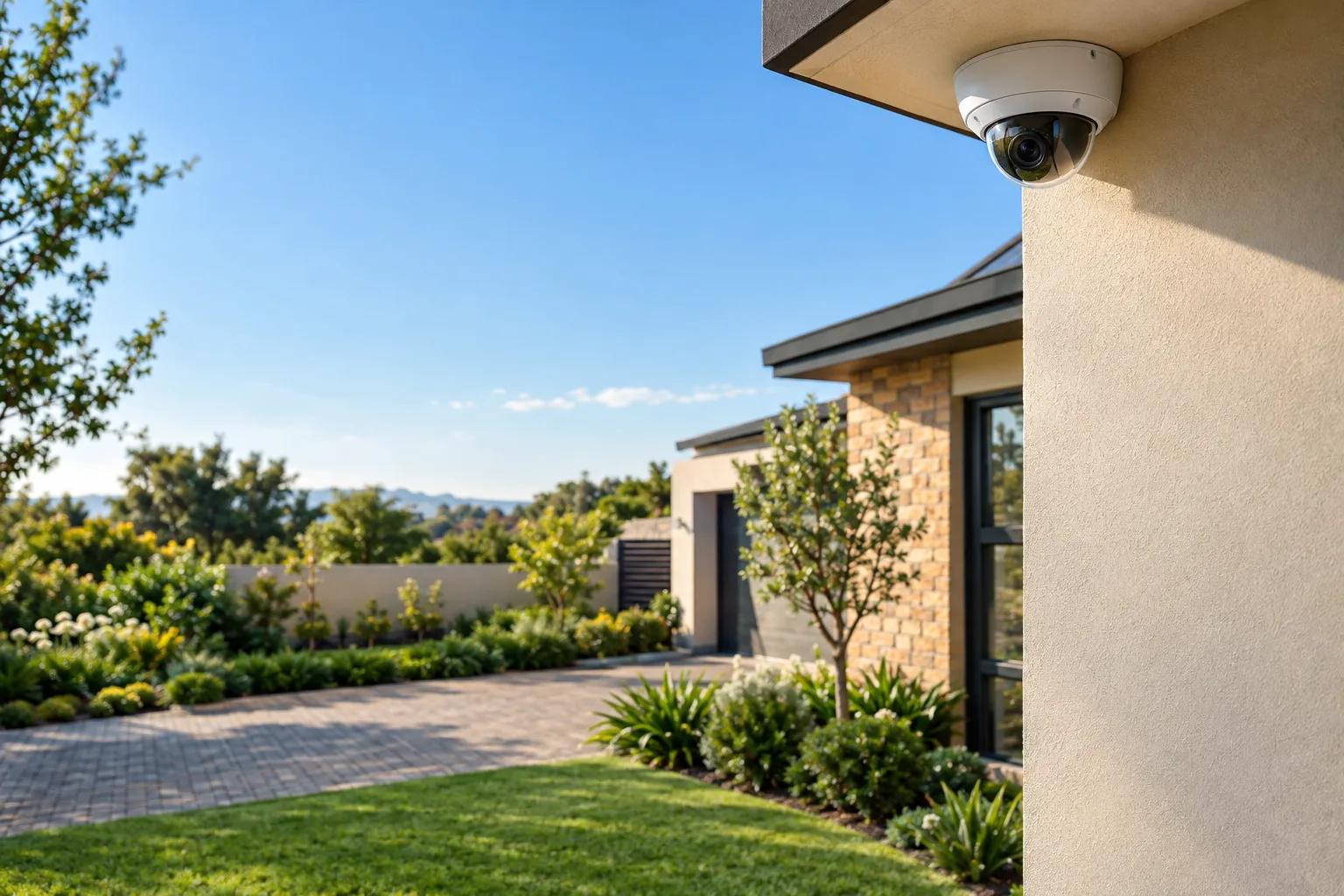
A dome camera on the corner of a plastered house overlooking the garden

CCTV installation

CCTV cameras for recording and live viewing at businesses, estates and homes.

Send us a message

We use your details only to answer your enquiry. Privacy notice.

What is CCTV?

CCTV, short for closed-circuit television, is a set of cameras recording to a private recorder on your property. You watch live and recorded footage on your phone, and cameras with AI analytics can tell a passing car from a man with a gun at your gate, so the alert you get is the one worth getting. The footage stays yours.

We supply, install, maintain and repair CCTV for homes, businesses and industrial sites.

Cameras for every kind of property

The right camera depends on what it needs to see, and from how far. A driveway camera must show a face at the gate, while a yard camera must cover a wide area at night.

  • Analogue cameras for straightforward home and small-business cover
  • HD digital cameras for clearer footage of faces and number plates
  • IP cameras sending their picture over your network
  • Number plate recognition cameras for gates and car parks
  • Facial recognition cameras for sites needing to know who is on the premises

The right camera for each spot

No single camera suits every spot. Some carry stronger infrared to see further across a large yard at night, while others have built-in technology to record in full colour. Wide-angle lenses cover a whole driveway or parking area, and narrower lenses zoom in on a gate or front door to pick out a face. Number plate cameras read the registration of every car coming through the gate.

A wide-angle camera can show a man crossing your yard and still leave his face too small to recognise. We match each camera to its position and its job, so you get the movement, the face and the plate.

Security lighting →

IP and analogue cameras on your phone

Both types work the same way on your phone: your cameras live stream video over your network, so you can watch from wherever you are. Nanny cams work this way too: they're small Wi-Fi cameras for inside and around the home, so you can check on the children and whoever is looking after them. We use high-end, reputable brands for these, not cheap online cameras, which can leave a live view of your home open to strangers.

At 1am the alarm goes off in the lounge. You open the app and see the camera covering the passive: the dog on the couch, or a window standing open. Linked to your alarm, cameras show you what triggered it, and why, before anyone drives out.

A screen can show a live picture for months while a failed hard drive records nothing, and you only find out the morning you need last night's footage and there's none to watch. So we set up the recorder, the network and the phone app to work together, and check the recorder is saving the footage before we hand over.

  • Higher image quality, so a face or a number plate is readable
  • Remote viewing from your phone or computer
  • Alerts when something moves where it shouldn't
  • Room to add cameras later without rewiring the house

Cameras linked to your alarm, or used as one

Cameras can work with your alarm or act as one. Cameras with AI analytics watch a trip line along a wall or driveway, and when a person crosses it, they sound a siren, flash a strobe light and send an alert to your phone or your armed response company.

A man drops over the back wall at 3am. Before he reaches the house, the camera on the corner picks him up, its siren goes off, and a recorded warning plays through its speaker. We plan the cameras and the alarm together, so each camera covers a zone worth protecting, and the footage stays on the recorder for later review.

Alarm systems →

When the power goes off

Cameras, the recorder and the router all need power. Without backup, the system goes off during a power cut, at the same moment the street goes dark.

We look at what needs to keep running, and for how long. A backup solution, from a battery to solar, can keep the recorder and the key cameras running through an outage.

Solar and battery backup →

Case study: solar-powered cameras for a new industrial park

At 2am on a half-built industrial site, there's no one around to hear an angle grinder. A transformer and its electrical equipment are worth a great deal, and copper is one of the first things thieves go for. With no fence and no lights, they could work all night and be gone by morning.

The transformer stood on a concrete plinth, out in the open. There was no power for cameras or lights, and nothing to slow anyone down. Green Leaf, at the newly developing Malibongwe Industrial Park, needed eyes on the equipment continually.

We put up a steel pole beside the transformer. Solar floodlights at the top have motion sensors, lighting up the area when anything moves. Below them, Wi-Fi cameras give a remote view of the ground around the equipment. We linked the cameras to a security guard, who watches the site from his guardhouse.

Everything runs on solar. There are no cables to trench and no power supply to wait for. If someone walks up to the transformer, day or night, the cameras send an alert. The guard sees it as it happens, in time to act before the equipment is gone.

CCTV: our gallery

Frequently asked questions

Can I watch my cameras on my phone?

Yes. With IP cameras or a recorder set up for remote viewing, you can watch live and recorded footage on your phone from anywhere with signal. You open an app, choose a camera and see what it sees, whether you're at work, on holiday or upstairs in bed. Many systems also send an alert to your phone when a camera picks up a person, with a clip of what it saw. Some cameras with AI analytics can tell a person from a car, a dog or a branch moving in the wind, which cuts down false alerts. We set up the recorder, the network and the app when we install, and test them with you before we leave. It should work on the first night you need it, not after a weekend of trying.

Do you service cameras someone else installed?

Yes. We service, repair and upgrade CCTV systems installed by other companies. Send us a message with what you have, and photos of the recorder and a few cameras if you can. On the visit, we look at the cameras, the recorder, the hard drive, the cabling and the power supply. Then we tell you what can be kept, what needs fixing and what needs replacing. Many systems need new angles, better lighting or a new hard drive more than they need new cameras. A camera pointed at a wall or a bright light can often be moved instead of replaced. If the system is too old to connect to your phone, we explain the options and the costs.

Can CCTV work with my alarm?

Yes. CCTV can be linked to an alarm system, so when the alarm is triggered you get an alert with footage of what set it off. At night, this means you can see whether it's a person, a cat or the wind before you go outside or call for help. Some systems send the clip to your armed response company too, so they know what they're driving into. We plan the cameras to cover the same zones the alarm watches, so every trigger has a picture. The link also works the other way on some systems, with cameras using AI analytics to trigger the alarm when a person crosses a set line. We check your alarm panel and what it can connect to.

Do IP cameras need Wi-Fi?

IP cameras need a network connection, but it doesn't have to be Wi-Fi. Many IP cameras are cabled to the recorder with a network cable, which also carries their power. A cable gives a stronger, steadier connection, doesn't drop when the Wi-Fi is busy, and is harder to interfere with. Wi-Fi cameras suit spots where a cable is hard to run, such as a far corner of a garden or a building across the yard. They still need power at the camera, from a plug or a solar panel. Your internet connection is only needed for watching from your phone, not for recording. If the internet goes down, cabled cameras keep recording to the recorder. We recommend the mix suiting your property.

What happens to CCTV during load-shedding?

CCTV keeps recording during load-shedding only if the recorder, cameras and network have backup power. Without backup, the system stops recording the moment the power goes off, and many break-ins happen during outages for this reason. With a battery backup sized for the job, the key cameras keep recording through the outage, and you can still watch them on your phone if your router and internet are backed up too. Cameras with built-in infrared keep seeing in the dark even when the outside lights go off. We check what needs to keep running and for how long, and size the backup to suit. Where a property needs more, solar power or a battery backup system can keep the cameras, alarm and gate running together through long outages.

How long does the recorder keep footage?

How long a recorder keeps footage depends on the size of the hard drive, the number of cameras and the picture quality. A typical home system keeps between one and four weeks before it records over the oldest footage. A bigger drive keeps more days. Higher resolution and more cameras use space faster, while recording only when there's movement makes the drive last longer. We size the recorder to keep enough footage to look back over, usually at least a couple of weeks. If something happens, you need time to notice, find the clip and save it before it's recorded over. We show you how to search by time and camera, and how to save a clip to your phone or a flash drive, before we leave the site.

Talk to us about your home and business security needs

You shouldn't have to sit at the bottom of your own driveway, wondering whether the gate will close. With Paul's Gates you won't. Send us a message or chat on WhatsApp, and we will come and look.

Send a message